Are you righteous, or do you show right-wise-ness? צדיק (tsaddiq) | just, righteous; #H6662 {on-the-path}
δικαιος | just, righteous; #G1342 {accompanying-forth-rising-away-determined-forth-to-vectored}
excerpts from Just Love discussion with Wayne & Tobie
Sherry Humphrey, at Burnham, USA-MEI came across a note I had scribbled down [awhile ago]. "righteousness was formerly spelled [as] rightwiseness."We pursue righteousness by pursuing the character of Christ
Kunga Esihle, at Soweto, GautengGod knows I want to know the meaning [of] "righteous". Just or upright.
James Leonard, at Cleveland, USA-OHGordon Fee pointed out that English is not quite adequate to convey the meaning of the Greek word-stem δικ-. English gets help from German and Latin stems, to form the words just- and right-. Thus we have justice, justification, just, justly, justify, and we have right, righteous, righteousness, rightly. I think Fee's point is that the δικ- words involve more than just forensic righteousness, but an active working of righteousness in [through]the believer.
Wayne Kenny, at Radcliffe, Bury, UK"righteous" has taken on a bit of negative shading in modern language. That may be because we hear it most often as part of the word "self-righteous",a rather scathing term for someone who thinks he is quite a good person -- almost certainly better than anyone around him -- and is in a position to judge others without being judged himself. The original word, however, is not negative...people described as "righteous" act from love of [in] serving others, and that love is "righteousness." This is commonly described as "the good of charity."
λογος ["logos"]
λογ | logistic | the solution | 'rendered-to-be-to-release' Consider a ship's log, whereby the path & success of the voyage records passage. Yahshua/Christ, the λογος of God, bears the mark of success as the source & solution [logos] to our halt, our distress & dilemma. Within its primary, logos has also been translated "saying", "word". The words λογος & γραφιας [sacred writings; scripture] do not share a common etymology. Philosophy: Plato regarded logos as if the soul of existence created by the divine. Aristotle had used the concept of logos to describe rules that govern rational thought; "logic".
Joao, Lisbon, PORTUGALGreek word meaning the principle that sustains the universe. John uses this term to show that the Logos wasn't an impersonal force, as the Greeks believed, but a Personal one, a true Person incarnated.
Andreas, GREECEThe Lord Jesus the Christ is the LOGOS of God.
The Lord Jesus the Christ is not the word (Lexies) of God.
Socrates definition of LOGOS = 'Logos is the Creative knowledge of God.' It is unfortunate that the English Language does not have a word (lexeis) for the Greek word Logos. Socrates said that only God has a Logos and man is not capable of having a Logos.
Chris, Saint Petersburg, USA-FLIt is something that I am struggling to get a handle on. My mind can hear it but my spirit struggles to see it. But there it is in all of our Bibles, The Logos of God.
O B E Y ↮ P E R S U A D E D
Are the persuaded ruled by obedience?
excerpt; Luther Walker
James, USA-VAIn Hebrews 13:17, most translations tell us to "obey" those who are leaders. In the Greek, the verb is in the middle voice and actually means to "be persuaded". Yet it is often translated "obey" in the active voice. Properly translated, we are to be persuaded by those who lead.
Jonah Lee, Penang Island, MALAYSIAThe 55 occurrences of "peitho" (be persuaded/convinced..), in their contexts, are never equated to submission or obedience to authority. By contrast, some words do mean "obey" [hear & heed] which are not used in Hebrews 13.For instance, υπακοη "obedience," υπακουο "obey" is such a word used in "children obey your parents" (Ephesians 6:1,Colossians 3:20), "slaves obey your masters" (Ephesians 6:5,Colossians 3:22), the winds and waves obeying Jesus (Matthew 8:27, Mark 4:41,Luke 8:25), demons obeying Jesus (Mark 1:27),and so on.The writer of Hebrews 13:17 could have used this word or something similar, but did not. Why? Because that was not the intention of the apostle. The translator deliberately translated it in a way to exert authority (over the laity). We remember this: The Kingdom's work is done through persuasion (love),not coercion (force).
George Sabin, Gresham, USA-ORI dread being sent to where I know that group or Church doesn't honor and flow in Him and let Him lead His own house. Yet I go because He is with me and has sent me for a purpose. Leaders follow Christ and speak Him, serving and washing feet. Yet they are not subject to, nor will they make others subject to a "dog pack, kiss the ring of the alpha (fake unity)"; nor are they subject/subjecting one another to a "swine herd, lemmings" (fake unity).Leaders [as all] keep the Unity of the Spirit and/in the Bond of peace; they operate in the gift of helps and intercession with "long-suffering and forbearance"; they serve in meekness to His will and lowliness to serve others towards Christ as does the Holy Spirit. They speak His words He backs with His power.
F O R G I V E N E S S ↮ R E M I S S I O N
αφεσ* [#G863] concurring, the impetus is relieved.
similar to: forego; forgive, freeing without a full pardon. {see Matthew 18:23-35}
αφεσις [#G859] as one forward, concurring, the impetus is relieved.
similar to: remission; recommission, freeing without a full pardon.
VERSE LIST for REMISSION αφεσις/-ιν/-ει [#G859]: Matthew 26:28;Mark 1:4; 3:29Luke 1:77; 3:3; 4:18(2); 24:47;Acts 2:38; 5:31; 10:43; 13:38; 26:18;Ephesians 1:7;Colossians 1:14;Hebrews 9:22; 10:18
Adebola Lawal, Lagos, NIGERIAIn whom we have redemption through his blood, the forgiveness of sins, according to the riches of his grace (Ephesians 1:7). In many places where the word "forgiveness" is used, it should actually be translated "remission." Remission means liberty, release, separation; it means letting go of the offense or offenses...
Bill Nelson, Middlesex, USA-NJIt can't be sin to remember something horrible that has happened in the past. When it comes to our mind. We choose not to dwell on it, preventing us from staying bitter or becoming bitter. When it says God won't remember [Hebrews 8:12 | μη μνησθω;not gnawingon the mind] your sins, God is not saying He is forgetful. He isn't going to dwell on your sin... What a great and wonderful loving God we have! What grace!
Allen Harmon, Ballard, USA-WVThe wonderful aspect of it all is that we can run to Him at any time and confess and be restored. [I John 1:9] That, of course, doesn't mean that you take your sins lightly and plan on enjoying them and then run get them forgiven. That in itself reveals a sinful heart attitude.
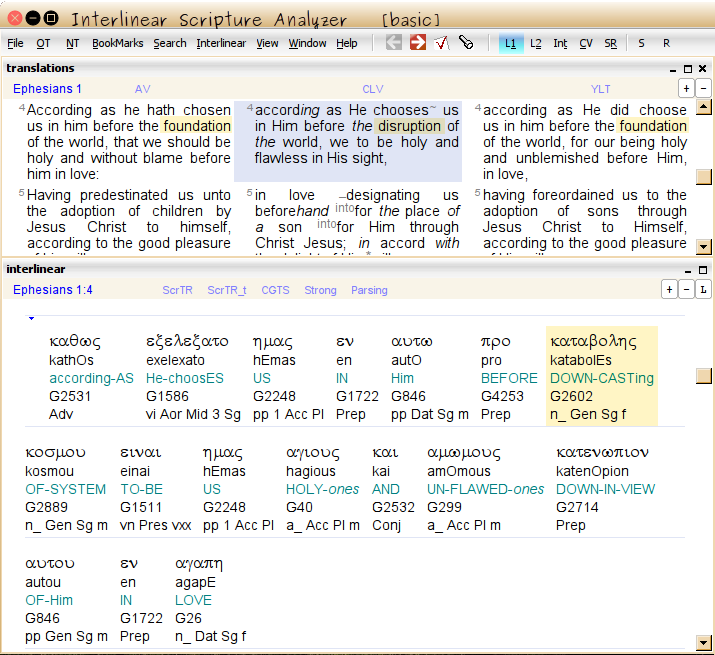
F O U N D A T I O N ↮ D I S R U P T I O N
καταβολης | casting-down | disruption [CLV]
VERSE LIST for καταβολης [#G859]: 1. use "disruption" for "casting-down" 2. + grammar [parsing, etc.] corrections
Matthew 13:35 [KJV] 35 That it might be fulfilled which was spoken by the prophet, saying, I will open my mouth in parables; I [Jesus] will utter things which have been kept secret from the foundation [καταβολης] of the world.
...I will utter things which have been kept secret from the disruption [καταβολης] of the world.
...I shall be uttering things 'having been kept secret' ['hiddened'] from the disruption [καταβολης] of the world.
Matthew 25:34 [KJV] 34 Then shall the King say unto them on his right hand, Come, ye blessed of my Father, inherit the kingdom prepared for you from the foundation [καταβολης] of the world.
...inherit the kingdom prepared for you from the disruption [καταβολης] of the world.
...tenant the made ready to you kingdom from the disruption [καταβολης] of the world.
Luke 11:50 [KJV] 50 That the blood of all the prophets, which was shed from the foundation [καταβολης] of the world, may be required of this generation;
...which was shed from the disruption [καταβολης] of the world, may be required of this generation;
...having been exacted from the disruption [καταβολης] of the world, from the generation of this:
John 17:24 [KJV] 24 Father, I [Jesus] will that they also, whom thou hast given me, be with me where I am; that they may behold my glory, which thou hast given me: for thou lovedst me [Jesus] before the foundation [καταβολης] of the world.
...that they may behold my glory, which thou hast given me: for thou lovedst me before the disruption [καταβολης] of the world.
...that they may be beholding the glory; the aid which thou givest me: that thou lovest me before disruption [καταβολης] of the world.
Ephesians 1:4 [KJV] 4 According as he hath chosen us in him before the foundation [καταβολης] of the world, that we should be holy and without blame before him in love:
---he hath chosen us in him before the disruption [καταβολης] of the world, that we should be holy and without blame before him in love:
---He chooses us in him before the disruption [καταβολης] of the world, we to be holy and without blame in view of Him in love:[ref: John 14:23]
Hebrews 4:3 [KJV] For we which have believed do enter into rest, as he said, As I have sworn in my wrath, if they shall enter into my rest: although the works were finished from the foundation [καταβολης] of the world.
---although the works were finished from the disruption [καταβολης] of the world.
---although of the works having became from the disruption [καταβολης] of the world.
Hebrews 9:26 [KJV] 26 For then must he [Christ] often have suffered since the foundation [καταβολης] of the world: but now once in the end of the world [Grk aion, age] hath he [Jesus] appeared to put away sin by the sacrifice of himself.
...he [Christ] often have suffered since the disruption [καταβολης] of the world: but now once in the end of the world [Grk. αιωνων; eon, age] hath he [Jesus] appeared to put away sin by the sacrifice of himself.
...he [Christ] as many times be suffering from the disruption [καταβολης] of the world: now yet once on the conclusion of the eons/ages] He hath been made to appear to the displacing of the sinning through the sacrifice of himself.
I Peter 1:20 [KJV] 20 Who verily was foreordained before the foundation [καταβολης] of the world, but was manifest in these last times for you
---verily was foreordained before the disruption [καταβολης] of the world, but was manifest in these last times for you
---furnished as known to prevail [foreknown] indeed before the disruption [καταβολης] of the world, prevailed to break-in yet on last of the times through you
Revelation 13:8 [KJV] 8 And all that dwell upon the earth shall worship him, whose names are not written in the book of life of the Lamb slain from the foundation [καταβολης] of the world.
...of the Lamb slain from the disruption [καταβολης] of the world.
...of the Lambkin, [one] having been held to be rendered as absent of impetus (or, "held alongside to be slain") from the disruption [καταβολης] of the world.
Revelation 17:8 [KJV] 8 The beast that thou sawest was, and is not; and shall ascend out of the bottomless pit, and go into perdition: and they that dwell on the earth shall wonder, whose names were not written in the book of life from the foundation [καταβολης] of the world, when they behold the beast that was, and is not, and yet is.
---whose names were not written in the book of life from the disruption [καταβολης] of the world, when they behold the beast that was, and is not, and yet is.
---not has been written the names on the scrollet of life from the disruption [καταβολης] of the world, seeing the wild-beast to be attended was and not is, and even-yet is.
Andy McLarity, Columbus, USA-MSAccording how this [Hebrews 9:26] is translated it would seem that there has never been a time when there was no sin in the world. Considering this view, it does not make sense. ... Two words are [have been] translated [as] foundation. They are not similar in meaning. They have no common elements. One meansplace-care and the other means down-casting.
F O R E S A K E N ↮ L E F T T O M E
ηλι ηλι λαμα σαβαχθανι » θεε μου θεε μου ινα τι με εγκατελιπες[Matthew 27:46]
ελωι ελωι λαμμα σαβαχηθανι; » ο θεος μου ο θεος μου εις τι με εγκατελιπες[Mark 15:34]
"God of me, God of me, wherefore (what) to Me You leave.(?)"
George Lamsa, Turlock, USA-CAThis phrase in Aramaic means, "My God, my God, for this I was kept.This was my destiny, or, for this I was born."
Marshall, Davie, USA-FLMatthew 27:46-50; Mark 15:34-37. By the context in both Matthew and Mark... just before Y'shua declines the vinegar offered Him and takes a last breath. Also, a more literal rendering of Psalm 22:1 [king David writing]... "God of me. God of me. To what have you left me?" John 19:28-30, Jesus then perceived all to be accomplished, and cries out "It is finished." He got His answer from the Father, as David also perceived his answer ~1000 years before.Forsaken & Abandoned are emotionally-charged words. The scene that dayat Golgotha wasn't short on emotion. However, context is helpful and, with help from our Father we now can understand κονη Greek aorist verbal tenses more accurately.
A P O S T L E ↮ S E N T O N E
"Truly the signs of an apostle were wrought among you in all patience;in signsand wonders and abilities." [II Corinthians 12:12]
on Shaliach, Apostolic servants & Apostles
Skip Moen, ITALY"As You sent Me into the world, I also have sent them into the world." [John 17:18].Notice that John’s text says that Yeshua empowers us as his fully authorized representatives... Under shaliah, this means that we do not present ourselves as individuals distinct from the sender. We are the sender. We are in the world as if he is in the world. Shaliah creates a chain of command so that Yeshua is the manifestation of YHVH and we are the manifestation of Yeshua.
Rick Fox, USA-MOin Greek culture, sailors were apostoloi, emissaries were apostoloi, cargo ships were apostolic ships. When we start with the Hebrew concept [shaliach]: Apostles represent Jesus, not institutions or churches... are sent to elders, not over them... deliver Christ's doctrine, order, correction, and equipping.
F L E S H ↮ S I N F U L N A T U R E
Yet the ones of the Christ, to-prevail-therewith-as-attended to flesh, impale together the sufferings/passionsand the lusts/desires. [Galatians 5:24]
σαρχ: flesh or your sinful nature? excerpt; Andrew Farley
Leah Dixon, USA-NJIt really comes down to, are you trying to please your [natural] self... your sinful nature, or your flesh? If I'm not entertaining God in the ways in which He's speaking to me, I'm choosing not to follow. Romans 8:12 NLT. "Therefore brothers, you have no obligation to do what your sinful nature urges you to do."
Giscard Nazon, Miami, USA-FLChristians like to talk about their sinful nature... Some Bible translations even take the word for "flesh" and they translate it: "sinful nature". So, people don't get to think about what the Bible means when it says "flesh". You have to crucify your flesh. The gospel is not, "We always will struggle with sin." That's not good news. Sin leads to death. If you are in Christ, you are not in sin.
Craig Hadley, Redlands, USA-CAShortly after the life, death, and resurrection of Jesus, Paul wrote a letter to the church in Rome. In that letter, he writes, "Therefore, just as sin came into the world through one man, and death came through sin, and so death spread to all because all have sinned..." [Romans 5:12]
~300 years later...
An unknown theologian, who scholars refer to Ambrosiaster, attempted to translate Paul's letter into Latin, mistranslated the Greek phrase "εφ ω" as "in whom" rather than "because" -- as shown in the translation above.
Because of this mistranslation, Ambrosiaster developed a theology in which one inherited sin rather than committed sin. They wrote,"So it is clear that all have sinned in Adam collectively, as it were. [Adam] was himself corrupted by sin, and all that were born were therefore all born under sin. From him therefore all are sinners, because we are all produced from him."
a little while later...
Saint Augustine of Hippo read the work of Ambrosiaster, and he quoted it directly when he was discussing a new idea: Original Sin. Augustine wrote, "Human nature was certainly originally created blameless and without any fault; but the human nature by which each one of us is now born of Adam requires a physician, because it is not healthy... But the weakness which darkens and disables these good natural qualities, as a result of which that nature needs enlightenment and healing, did not come from the blameless Maker, but from original sin…For this reason our guilty nature is liable to a just penalty."
Not everyone agreed with Augustine. A theologian in Rome, named Pelagius, pushed back on Augustine's ideas. He wrote,"We are not born in our full development, but with a capacity for good and evil... we are begotten without virtue as much as without fault... and before the activity of the individual will, there is nothing in humans other than what God has placed in them."
In other words, when Pelagius looked at a baby, he saw the face of God. When Augustine looked at a baby, he saw the face of the Devil.
The Roman Church has adopted the doctrine of Original Sin largely because of the mistranslation of one phrase.
and there's more...
The Hebrew word for sin [ חטאת ] isn't even in the first three chapters of Genesis. In the words of rabbi Simon Jacobsen,"The concept of 'Original Sin' does not exist in Judaism."
From Genesis 3, God does not kick Adam and Eve out of the garden because they sinned. God kicks them out, because He is worried [concerned?] they will become powerful in now understanding the difference between good and evil.
P R O V I D E ↮ $ $ $
προνοεο [G4306] appears 3 times in the New Testament writings; a compound of the prefix "pro-" (before), and "noeo" (think): to consider beforehand. At I Timothy 5:8, "if any does not provide for his own..." has snared some to regard money as the would-be or sufficient provisionfor family. By way of reminder, προνοει describes thought; to consider, regard.This in contrast to:provide earnings or currency; professional servicesor entertainment; conveniences or substance of desires, etc.
"Jehovah Jireh: the Lord Provides" as "my God shall supply all your needs according to His riches in glory in Christ Jesus."[Genesis 22:14; Philippians 4:19]
Tola Odutola, Baltimore, USA-MD1 Timothy 5:8 is often misunderstood as a direct command for husbands to financially provide for their wives, but its context is actually about the care of widows...
Travis Young, Sandpoint, USA-IDthe Bible says nowhere that the husband is to be the provider for the family, it only states that both the husband/man and wife/woman should be productive...(Proverbs 31;1 Thessalonians 4:11;2 Thessalonians 3:10-12).God is the One that Provides...
Jonathan Blundell, USA-TXI don’t believe provide for has to mean working a paying job every day....a better explanationof 'provide' in this use would be "care for" which is what several translations have opted for instead.
T H E D A Y ↮ D A I L Y
The "daily bread" of legacy translation leaves us with the taste of "every day". From the modern Greek "καθε ηερα" meaning "every day" or "daily", does not appear in the New Testament writings. Instead, "καθ ημεραν" meaning "according to the day" present at 17 places.
the cross-confusing conflict:
"lift the cross of him, according to the day also be following Me" exchanged for "take up his cross daily, and follow Me". [Luke 9:23]
"teaching according to the day" presented as "teaching every day" [Luke 19:47]
"searched the scriptures according to the day" becomes "searched the scriptures daily" [Acts 17:11]
"according to the day I am from dying off" reduced to "Daily I am dying" or, "I die daily." [I Corinthians 15:31]
This error finds origin in the Latin Vulgate translation: cotidie {adverb} meaning: "each day" or, "every day".
For most occurences, the English "daily" or "every day" would introduce a contextual conflict.
Jacques Lemieux, Nova Scotia, CanadaIt means Galatians 2:20
Col Stringer, Queensland, AustraliaMany people are confused by Paul’s reference to 'dying daily' as though we must do the same. But we have been crucified with Christ. Scripture tells us to reckon ourselves dead to sin.
Wasike, Busia, Kenyathe cost of being a disciple of Jesus Christ... follow Him every day.
P E R F E C T M I S U N D E R S T A N D I N G
English "perfect" can mean:
entirely without fault
faithfully reproduced
pure; total
absolute
sure; certain
abstractly ideal
unmitigated
satisfying requirements
mature
complete; consummate
Which definition(s) from the above list best fit within each context referenced below?
Matthew 5:48; 19:21;John 17:23;Romans 12:2;I Corinthians 2:6;II Corinthians 13:10;Galatians 3:3;Philippians 3:12,15;Colossians 1:28; 4:12;Hebrews 6:1; 13:20-21;James 1:4; 3:2; I John 4:18...
Yes, #9 & #10 are the better match for these.
τελ- | to-release-essential-as-attended
Peter von Bergen, Hamburg, GermanyThis is a common misunderstanding among christians. especially those who tend to [toward] legalism. The Greek word τελειος [téleios] that is usually translated as "perfect" has in the original more of another meaning... like "mature" or "having reached the point of fulfillment" or "consistent".
Gail Wysocki, USA-VAI can go forward and not wallow
around in my mistakes..
Starr Groff, [itinerant]Completeness and Wholeness: In the Old Testament, the Hebrew word often translated as "perfect" is tamim. This word signifies being complete, entire, or blameless. For example, Noah is described as being "perfect inhis generations"[Genesis 6:9], which means he was a man of integrity and completeness in his relationship with God, living blamelessly in his time.
In this [New Testament] context, to be "perfect" is to be spiritually mature. This is seen in passages like Hebrews 6:1, which urges believers to "go on unto perfection," meaning, to move from the basic principles of faith toward spiritual maturity
R U L E ↮ S T A N D
προστεμι [G4291]: ready in the lead in/for the home, with ministry, care, in good works...
The word impute has largely drifted in meaning, today often in use as laying responsibility or blame.Its etymology from the Latin, putare: to consider. λογιζεται or ελλογεται as to find or calculate a solution, or to render for one. [Romans 4:3-24; 5:13;Hebrews 11:19;Philemon 1:18; James 2:23, etc.]



 ηλι ηλι λαμα σαβαχθανι »